Welcome to my Daily Inspiration - Daily Quote. See today's daily inspirational quotes below.
May the world be kind to you, and may your own thoughts be gentle upon yourself. - Jonathan Lockwood Huie
Showing posts with label trigger words. Show all posts
Friday, September 7, 2018
Labels are for Cans, Not People
When we label anyone 'bad', we will have more trouble
dealing with him than if we could have settled for a lesser label.
- William Glasser
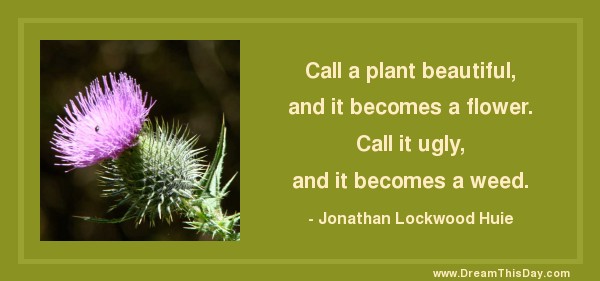
Call a plant beautiful, and it becomes a flower.
Call it ugly, and it becomes a weed.
- Jonathan Lockwood Huie
Read about the power of naming.
Labels have the negative value of making smaller boundaries for people.
- Michael Graves
People always want to put a label on you;
they always want to compare you to something.
- Carrot Top
Labels are for cans, not people.
- Anthony Rapp
I try to look for the good in everybody,
regardless of the way they're labeled.
- Richard Thompson
Further reading: Judging Others
Categorizing People
Perspective
See no evil, Hear no evil, Speak no evil
What Do You See?
Tuesday, September 9, 2014
The Illusion of Knowledge
The greatest obstacle to discovery is not ignorance -
it is the illusion of knowledge.
- Daniel J. Boorstin
What people believe prevails over the truth.
- Sophocles
Class, race, sexuality, gender and all other categories
by which we categorize and dismiss each other need
to be excavated from the inside.
- Dorothy Allison
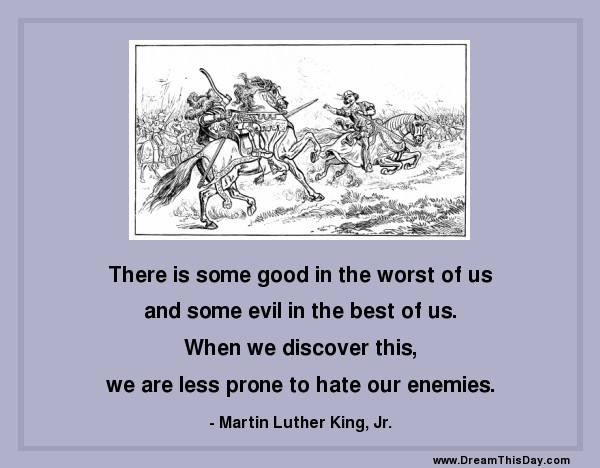
There is some good in the worst of us and some evil in the best of us.
When we discover this, we are less prone to hate our enemies.
- Martin Luther King, Jr.
Truth is not defined by
how many people believe something.
Ask. Question. Think.
Decide - for yourself.
- Jonathan Lockwood Huie
Further reading: The Nature of Belief
Assumptions
Expectations - Demands
What`s in a Name?
Who am I to Judge?
Labels
Friday, May 23, 2014
Labels
Call a plant beautiful, and it becomes a flower.
Call it ugly, and it becomes a weed.
- Jonathan Lockwood Huie
Read about the power of naming.
People always want to put a label on you;
they always want to compare you to something.
- Carrot Top
When we label anyone 'bad', we will have more trouble
dealing with him than if we could have settled for a lesser label.
- William Glasser
Labels are for cans, not people.
- Anthony Rapp
Labels have the negative value of making smaller boundaries for people.
- Michael Graves
I try to look for the good in everybody,
regardless of the way they're labeled.
- Richard Thompson
Further reading: Categorizing People
What Do You See?
Perspective
Judging Others
See no evil, Hear no evil, Speak no evil
Perception
Friday, September 25, 2009
The Nature of Belief
What do you believe? Why do you believe that? What is the fundamental nature of belief?
Is a belief a perception of the five senses or is it a perception of emotional feeling? Is it better to say "I sense" and/or "I feel"? Is it better to say " I know" than "I believe"? Is belief based on experience or on a idea? My thinking is that belief/believing is a very missed used word.
- Anonymous
These are BIG questions with several facets...
Language: Before we can get down to true thoughts and feelings, we have to deal with language. We may call it "English," but we don't speak the same language. We have regional differences and cultural differences as well as personal differences. In addition, our language is changing rapidly. We may agree on words like "door" and "walk," but words like "belief" and "God" call up different images for each of us.
Some words are "trigger" words. "Liar" is certainly a trigger word for many people. It creates an emotional reaction that is way beyond the literal meaning of the word. I once discovered to my dismay that the word "scapegoat" is that kind of trigger word for a few people. It is very easy to use someone else's trigger word in a completely innocent way, as I did, and then be accused of making a racial, religious, gender, or personal slur.
Getting back to "belief," when one is having a deep one-on-one conversation, it is worthwhile to create a mutual working definition of the key terms of the conversation, such as "belief." In public speaking or writing, sometimes it is important to state one's own definition of key terms, as I do in my book Simply An Inspired Life.
On a day-to-day basis, however, just be clear with yourself about what you mean in conversations with others and especially with yourself.
In everyday conversation, I seldom attempt to be truly precise in my speaking. Like most people, I say "It's a beautiful day." and "The cheesecake is terrible." and "He shouldn't talk to her like that." I KNOW those are merely my opinions, but it's impractical to label everything I say as being my opinion. Everything I and everyone else ever says or thinks is merely an opinion, whether it regards the nature of God or the state of the cheesecake.
So how do we form our opinions? Our opinions (or our beliefs, feelings, prejudices, or knowledge, if you prefer) come from only two sources, our genetics and our history. "Prejudice" is another trigger word, but it describes an often-valid practice. Our ancestors wouldn't have survived without prejudice. If I watched my father being eaten by a lion, I become prejudiced against all lions. Perhaps the next lion would be friendly, but ... NO, of course I don't think religious, racial, or similar prejudices are acceptable, but I do understand that they are based on instinctive generalizations.
Whether we say "It is my opinion," "I believe," "I feel," "I sense," "I know," or just state something as if it were a fact (such as "The cheesecake is terrible."), we are speaking about our perception of the world as we relate to it, and cannot with any validity imagine how others perceive their worlds. Moreover, I contend that it is presumptuous for us to think we know how others SHOULD perceive their worlds.
Further reading: Suggestions for Reading Daily Inspiration - Daily Quote
Meddling - 5 Questions To Ask Yourself Before Offering Helpful Advice
Friedrich Nietzsche: There are no facts, only interpretations
Perspectives on the Nature of God - Which of these Five Views Matches Yours?
Oscar Wilde quote: Morality is simply the attitude we adopt towards people whom we personally dislike.
Is a belief a perception of the five senses or is it a perception of emotional feeling? Is it better to say "I sense" and/or "I feel"? Is it better to say " I know" than "I believe"? Is belief based on experience or on a idea? My thinking is that belief/believing is a very missed used word.
- Anonymous
These are BIG questions with several facets...
Language: Before we can get down to true thoughts and feelings, we have to deal with language. We may call it "English," but we don't speak the same language. We have regional differences and cultural differences as well as personal differences. In addition, our language is changing rapidly. We may agree on words like "door" and "walk," but words like "belief" and "God" call up different images for each of us.
Some words are "trigger" words. "Liar" is certainly a trigger word for many people. It creates an emotional reaction that is way beyond the literal meaning of the word. I once discovered to my dismay that the word "scapegoat" is that kind of trigger word for a few people. It is very easy to use someone else's trigger word in a completely innocent way, as I did, and then be accused of making a racial, religious, gender, or personal slur.
Getting back to "belief," when one is having a deep one-on-one conversation, it is worthwhile to create a mutual working definition of the key terms of the conversation, such as "belief." In public speaking or writing, sometimes it is important to state one's own definition of key terms, as I do in my book Simply An Inspired Life.
On a day-to-day basis, however, just be clear with yourself about what you mean in conversations with others and especially with yourself.
In everyday conversation, I seldom attempt to be truly precise in my speaking. Like most people, I say "It's a beautiful day." and "The cheesecake is terrible." and "He shouldn't talk to her like that." I KNOW those are merely my opinions, but it's impractical to label everything I say as being my opinion. Everything I and everyone else ever says or thinks is merely an opinion, whether it regards the nature of God or the state of the cheesecake.
So how do we form our opinions? Our opinions (or our beliefs, feelings, prejudices, or knowledge, if you prefer) come from only two sources, our genetics and our history. "Prejudice" is another trigger word, but it describes an often-valid practice. Our ancestors wouldn't have survived without prejudice. If I watched my father being eaten by a lion, I become prejudiced against all lions. Perhaps the next lion would be friendly, but ... NO, of course I don't think religious, racial, or similar prejudices are acceptable, but I do understand that they are based on instinctive generalizations.
Whether we say "It is my opinion," "I believe," "I feel," "I sense," "I know," or just state something as if it were a fact (such as "The cheesecake is terrible."), we are speaking about our perception of the world as we relate to it, and cannot with any validity imagine how others perceive their worlds. Moreover, I contend that it is presumptuous for us to think we know how others SHOULD perceive their worlds.
Further reading: Suggestions for Reading Daily Inspiration - Daily Quote
Meddling - 5 Questions To Ask Yourself Before Offering Helpful Advice
Friedrich Nietzsche: There are no facts, only interpretations
Perspectives on the Nature of God - Which of these Five Views Matches Yours?
Oscar Wilde quote: Morality is simply the attitude we adopt towards people whom we personally dislike.
Labels:
belief,
communication,
emotions,
feelings,
language,
liar,
opinions,
perception,
prejudice,
thinking,
trigger words
Subscribe to:
Posts (Atom)
You can also have Jonathan Lockwood Huie's Daily Inspiration email sent by Follow.it - Choose the email service you prefer...