Welcome to my Daily Inspiration - Daily Quote. See today's daily inspirational quotes below.
May the world be kind to you, and may your own thoughts be gentle upon yourself. - Jonathan Lockwood Huie

Monday, October 5, 2009

Pain is inevitable, Suffering is optional. - Buddhist proverb


Pain is inevitable, Suffering is optional.
- Buddhist proverb

Pain is what the world inflicts upon us. Suffering is our emotional reaction when we fail to make the difficult conscious decision to choose Joy.
- Jonathan Lockwood Huie

Nobody can hurt me without my permission.
- Mahatma Gandhi

Gandhi's observation is fundamental to walking the path of a joyful life, but do understand that by "hurt" Gandhi means emotional suffering rather than physical pain.

Think of the playground rhyme, "Sticks and stones can break my bones, but words can never hurt me." In real life, most of us often feel very hurt by the words of others, but we can choose to moderate those feelings of perceived injury.

Further reading: Wisdom of Gandhi

Joy is a Choice - but Not an Easy Choice - jlh

Perspective on Tradition: An Open Mind

Joy blooms where minds and hearts are open. - jlh

Sunday, October 4, 2009

Ralph Waldo Emerson : Nothing great was ever achieved without enthusiasm.

Nothing great was ever achieved without enthusiasm. 
- Ralph Waldo Emerson

Ideas, yes.
Inspiration, yes.
Creativity, yes.
Planning, yes.
Perseverance, yes.
More perseverance, yes.

And overarching all those, the success of a project is best predicted by the enthusiasm of its participants.

Affirmation: I live with enthusiasm, and give thanks for my life.

Further reading: Robert F. Kennedy quote: Only those who dare to fail greatly can ever achieve greatly

Mark Twain quote: Twenty years from now you will be more disappointed by the things you didn't do than by the ones you did do. Throw off the bowlines.

A life lived in fear is a life half lived

ACTION - the sixth Point of Simply An Inspired Life

Saturday, October 3, 2009

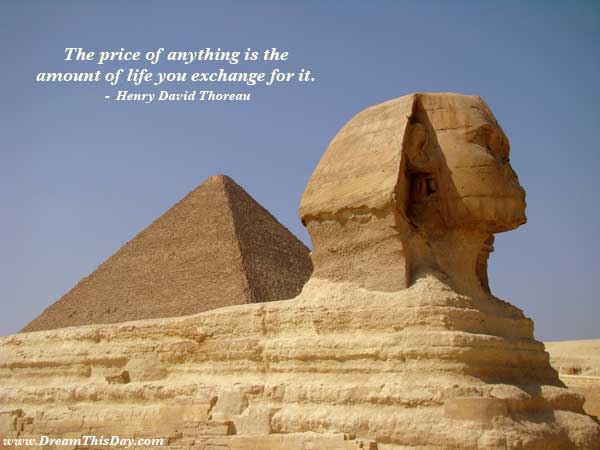
Henry David Thoreau: The price of anything is the amount of life you exchange for it.

The price of anything is the amount of life you exchange for it. - Henry David Thoreau

What is money? Money is a representation of the number of hours you worked to earn it. So money represents a quantity of your life. But the effort you expend is not always represented by money. For example, time you spend doing yard work or housework, or time you spend helping someone else.

So, as Thoreau points out, the price of anything can best be measured in the amount of life you exchange for it, both because that metric includes effort for which money is not exchanged, and because it is a more intuitive and visual measure.

Now, consider whether you are receiving good value for the amount of life you are exchanging.

Further reading: Joy is a Choice - but Not an Easy Choice

Be Happy Dont Worry Quotes - Stop Worrying and Be Happy

A Story of Money

Do You Own Your Money and Stuff Or Do They Own You? - Take This Quiz to Find Out

Friday, October 2, 2009

Henry David Thoreau: The question is not what you look at, but what you see.

The question is not what you look at, but what you see. - Henry David Thoreau

It all depends on how we look at things, and not how they are in themselves. - Carl Jung

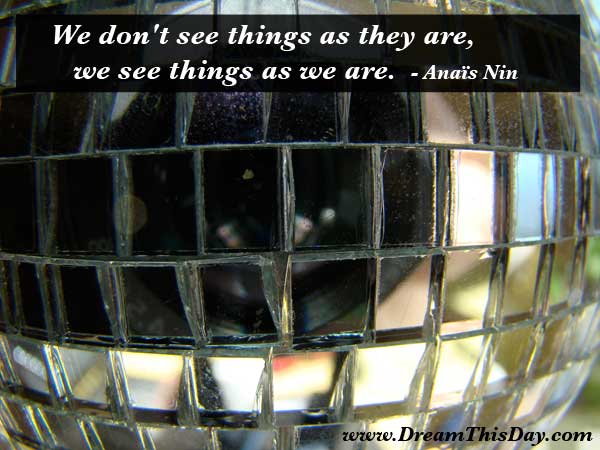
We don't see things as they are, we see things as we are. - Anaïs Nin

People only see what they are prepared to see. - Ralph Waldo Emerson

The beauty does not live out there; the beauty's in my eyes. - Jonathan Lockwood Huie

The idea that things and events do not have an absolute nature is part of our heritage of timeless wisdom. This same idea has been expressed in many different ways throughout history.

Further reading:
Anais Nin: We don't see things as they are, we see things as we are.

Friedrich Nietzsche: There are no facts, only interpretations

Never Let Anyone Get Your Goat

Visualize a kinder world

Perspective on Tradition: An Open Mind

The most dangerous phrase in the language is,
"We've always done it this way."
- Grace Hopper


A question is asked and the answer returns, "Because we've always done it that way." Perhaps that isn't the most inspiring answer possible, but it reflects at least a moment's consideration of the question, and for me, that's a good thing. Why do you drive a Ford? Because my family has always owned Fords. Okay by me.

However, when a question is asked and the answer is "Huh?" we are dealing with something of an entirely different nature. Let's say you are an American male, and the question is, "Why do you wear pants and a shirt?" "Huh?" Perhaps the actual answer is a snotty, "Because I'd look funny in a dress," but it still means, "Huh? That's not even a question." Of course the reason virtually all American males go into the world in pants and shirt rather than dresses, kilts, kimonos, jumpsuits, pajamas, bathrobe, or whatever is that virtually all other American males wear pants and shirt. Purely cultural.

You're Christian (most denominations), "Why do you take off your hat in church?" "Respect." "How is taking off your hat respectful?" "Huh?" You're Jewish, "Why do you wear a yarmulke (hat) in Synagogue?" "Respect." "How is wearing a hat respectful?" "Huh?" Of course religious experts would have ready references to "answer" the question, but that is just another way of saying, "Because my culture has done it that way for centuries."

The point of this writing is NOT that we SHOULD do anything differently from the way we have "always done it." In many cases, it would be downright foolhardy to buck cultural norms. That the people of some political unit agree to drive on the right (or left) side of the highway is purely cultural, like agreeing to wear or not wear head covering during worship. However, a unilateral personal decision to choose the other side of the road would risk a fine, imprisonment, or grave bodily harm. Same for choosing not to pay taxes, or to refuse military conscription or jury duty.

The point here is not about changing what we do, it's about thinking, about awareness, and about choosing. Become AWARE of the cultural norms that pervade our lives. THINK about the alternatives. CHOOSE, based on free-will.

Usually, our free-will choice will be to do exactly the same as our parents, and our family, and our neighbors. Great! Choosing to drive on the same side of the roadway as our neighbors is going to prevent a great deal of conflict.

Surprisingly often though, starting to question our cultural norms will open new vistas for us. Maybe something as simple as a Northerner discovering they love okra and gumbo. Maybe something as life-altering as the revelation of preferring not to become a parent, or that one's preferred home is a boat or an RV rather than a fixed location.

As an aside about cultural rigidity, as an American citizen, you are REQUIRED to be a resident of one of the 50 states and to have a fixed address. Legally, you can't "live" on a boat or in an RV, although millions do, and arbitrarily choose a state and drop box as their legal address. Question: "Why does one have to be a legal resident of one of the 50 states rather than just a resident of the United States as a whole?" Answer: "Huh?" Cultural norms change very slowly.
You can also have Jonathan Lockwood Huie's Daily Inspiration email sent by Follow.it - Choose the email service you prefer...
Get new posts by email: